StickMetrix; The power behind your swing!
The StickMetrix Bat Selector relies on hard data based on mass property measurements gathered from
individual bats using our proprietary Swing Scale which Combines 6 measurements into one!
The measurements are stored in a portable, scalable proprietary database, which allows the user to browse
and filter bat specifications using all 6 measurements in a meaningful way.
To aid in the bat fitting process; The StickMetrix bat selector computes additional performance criteria and
produces a rating that ties the bat’s inertial properties to the batter’s physical ability regardless of his or her skill level.

Bat fitting tips using the Swing Max application

Bat weight is an important consideration for batters of all skill levels. Heavy bats are usually associated with
solid hits and fast balls while lighter bats are thought to be faster and more responsive.
As a general guideline;
‐Bat weight is not as important as weight distribution
‐Bat Weight is not as important as batting speed.
‐A 5 oz (140 gr.) weight reduction can result in a 2 mph (1m/s) increase in batted ball speed and…
‐A 1.0 Mph bat speed increase yields a 5ft gain in distance. (0.5 m/s bat speed for 1.5 m distance gain)
‐A ball bounces better off a heavy bat than a lighter one.
Center of Mass (CM) or Balance point (Bp)
The location of the Bp hints at weight distribution between the knob and the barrel end of the bat.
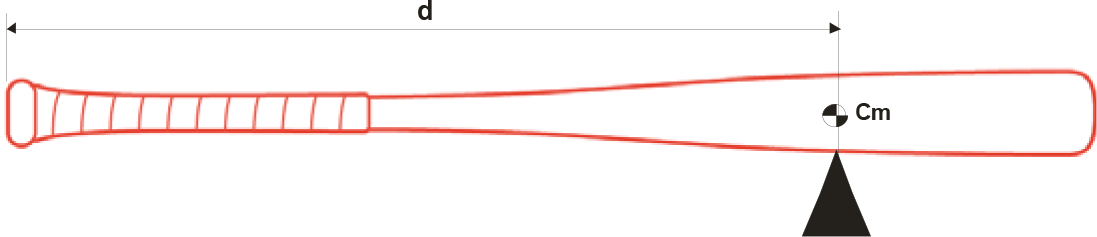
When the balance point (BP) is located along the tapered length of the bat; it is knob loaded. The bat can
be swung fast as would provide little resistance since ½ the bat weight would be closer to the wrists. This has
the same effect as chocking on the handle.
When the Bp is about the barrel, the bat is “barrel loaded” and would require more effort to swing and is
therefore potentially slower and more powerful.
As a general rule:
‐A barrel loaded bat is preferable to a knob loaded bat.
‐A barrel loaded bat is comparatively slower and requires anticipation.

Bat length is a double edged sword and one has to be careful when evaluating bats. These are key facts that
need serious consideration:
‐Bat length and weight go hand in hand. The longer the bat the heavier it gets. This is especially true of wooden
bats. Composite and aluminum bats can be made longer while generally keeping weight under control.
‐Longer bats require more effort to swing, because of the higher swing weight (MOI) which places the Balance
point (Bp) further away from the hands.
‐The longer of two bats of equal weight and swing weight, moving at the same angular velocity, produces
faster ball speeds and distance.
‐The longer bats provide greater reach but also require greater anticipation.
‐For equal mass (weight) and moment of inertia, the
longer bat is preferred. Note that a 1.0 Mph (0.5 m/s) bat speed increase results in a 5ft (1.5m) gain in
distance. This roughly a gain of 2% per ½” of length, assuming the impact point shifts as much towards the tip end of the bat.
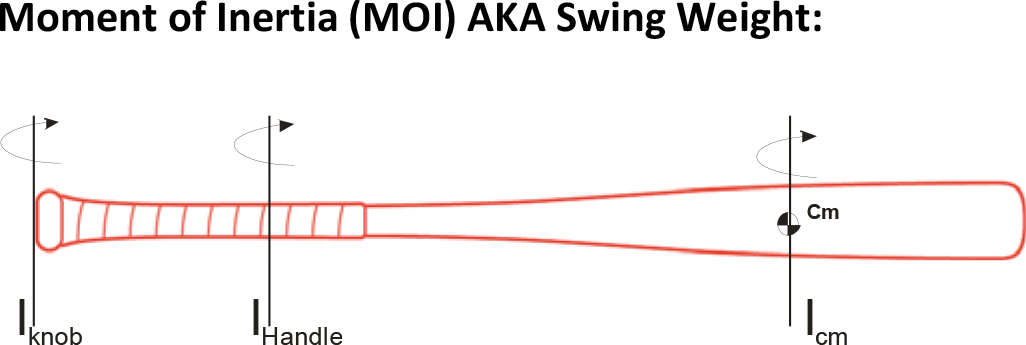
The ability of bat to resist circular motion. The quantity involved is moment of inertia MOI aka swing weight.
The quantity is usually expressed in Kg.cm2 or Once Square Inch (Oz.In^2).
The MOI is defined by the rotation axis about the bat. This could be at the knob end (Iknob) or 6 inches away
from the knob (Ihandle or I6 ) Then there is the MOI taken about the center of mass or balance point (Icm)
The only two Rotation axes that count are Iknob and Icm which are pretty much at the core of the most prevalent bat/swing analytics.
Thus when comparing Swing weight / MOI across a range of bats; the axis of rotation must be the same for the comparison to be a meaningful one.
The StickMetrix instrumentation provides calculated MOI values for Icm and Iknob with both derived from mass property measurements.
Some facts about MOI / Swing weight
‐The further away the (Bp) is from the knob end of the bat the larger the MOI.
‐Heavy bats do not necessarily have a high swing weight which is dependant on weight distribution and length.
‐Accelerating a bat with a large MOI requires more effort when compared to a bat of a lower swing weight.
‐Reducing MOI by 13% increases bat speed by 4%
‐No appreciable speed loss or gain is to be had when the MOI differential between two comparable bats is
less than 1000 Oz^2 or 180 Kg/cm^2. Preferences aside; the lighter/longer bat is the one to go for.
‐A proficient batter would be able to detect a 2.5% change in bat to bat MOI, while a novice batter would need a 25% change to notice the difference.
Center of Percussion COP
The COP is not a performance indicator per see; however knowing where the COP is located on the barrel informs the learned player how the bat would
“sting” when the bat/ball collision is less than optimal.
Owing to the Bat’s weight distribution; when the COP is located substantially forward of the Bp the residual impulsive shock will be much less than when the COP is
closer to the BP and therefore much less of a sting will be felt in the hands.
Ideally, The COP should fall forward of the Cm/Bp,roughly 70~75% of the bat length starting at the knob.

The approximate impact point on the barrel that would result in the fastest ball exit velocity with very little
residual vibration felt in the hands of the batter. This ideal impact spot lies between the Cm and slightly
forward of the COP towards the barrel end.
In other words, the Q zone as described is the active zone of the barrel where the inertial and elastic
properties (barrel stiffness) of the bat combine with those of the ball to determine the collision efficiency
(COR) and resulting ball exit speed
Some facts to remember when selecting a bat:
‐Maximum batted Ball velocity drops at a rate of about 10 Mph per inch (4.5 m/s per 2.5 cm) when the collision
occurs on either side of the optimum impact point
Bat Velocity Potential:
The maximum linear bat speed at or about the ideal impact zone that could be achieved based on a
standardized swing speed function with dependency on the bat’s inertial properties. The model is in line with
current research and provides the prospective batter with a base line metric that has string correlation with
swing weight / Bat MOI independently of any other factor that may affect bat performance like COR etc.
The Bat velocity potential greatly simplifies the bat selection process since it summarizes the batter’s end
goal in one single selection criteria.
Batted Ball Speed:
Batted ball speed is computed using the bat’s velocity potential from its inertial properties and assumes that
the bat is .500 BBCOR.
Pitched ball speed is the only user variable that may be encountered in the field that could affect the batted
ball speed. Batted ball speed holds true for either softball or baseball and any variant in between as long
as the correct parameters are selected.
Ball weight, COR and pitched ball speed are accessed from within the App global settings and need only be set once.
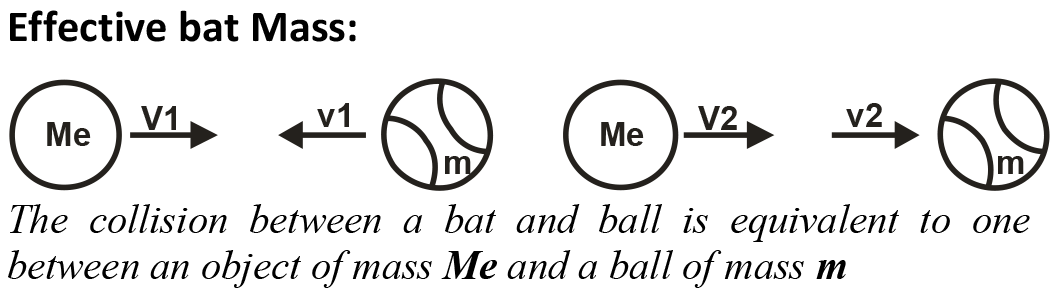
Me; is the fraction of the bat mass that directly contributes to the bat/ball collision. The effective bat
mass is unity when the ball is truck about the CM and decreases rapidly as the impact point moves closer towards the tip.
The effective bat mass Aka “intrinsic power” is calculated for the “Q zone” (barrel active zone)
The effective bat mass is less than that of the bat.
Recommended body Mass:
The body mass calculation ties the bat’s velocity potential to the batter based on the bat’s inertial
properties and the conservation of angular momentum, correlating torque and acceleration with lean body mass
for a healthy and athletic individual.
The value as derived is a starting point towards selecting a bat that falls within the ability of the batter
and which bat can be further optimized for both power and control instead of outright swing velocity.
As a general guideline;
‐if the bat is within the weight range of batter (+/‐10%);
dropping the bat inertia by 2.5~5% would result in improved control and a better response time (bahill)
‐a 10% increase in muscle mass would lead to a 3.8% increase in bat speed. (Nathan)
Bat MOI Rating (BMR)
The performance of a base ball bat lies in its intrinsic power and its inertial properties which dictate both the
maximum swing velocity and the potential kinetic energy build up that can be transferred to the ball when
properly struck.
The Bat MOI Rating (BMR) correlates the combined effect of the bat’s swing weight (MOI) on swing speed,
and the effective bat mass about the center of percussion on the potential kinetic energy build up that
can be transferred to the ball using the relation V~1/ I0 and Me~1/M+b2/Icm (Cross & Bowers).
The BMR does not take into account the ball/ bat collision into account since all compliant bats are
limited to a BBCOR approximating the Performance of wooden bats and thus the BMR as formulated gives the
Prospective batter the means to differentiate between Bats across all makes and materials using the bat’s
inertial properties and the batter’s weight class as the only selection criteria that best suits their Physical ability.
Drop Weight:
A popular base ball bat classification metric. The drop weight is the bat’s weight in ounces minus its length in
inches; for example, if the bat weighs 30 ounces and the length is 33”, the drop weight is ‐3.
Bats range from ‐3 to ‐13 in drop weight, with weights closer to ‐3 feeling heavier and weights closer to ‐13
feeling lighter. This is a practical over simplification of mass over inertia conundrum since two bats of equal
drop weight could have substantially different MOI’s.
Additionally a bat’s drop weight is too coarse of a metric to account for subtle variations in a bat’s performance
characteristics.
|


